

How a Water Leak Detector Works and Why Every Home Needs One
A water leak detector works by sensing water contact or unusual water flow, then triggering an alarm or alert to your phone or monitoring centre. Placed near sump pumps, sinks, and water heaters, it helps catch leaks before they become floods.
A burst pipe or a failed sump pump rarely announces itself. Sometimes it's just a few drops pooling under a sink, easy to miss until floors and drywall are already wet. By the time most homeowners notice water on the basement floor, it has often been soaking in for hours.
A water leak detector closes that gap, giving homeowners an early-warning system for one of the most common causes of home insurance claims.
At PasWord Protection, we take your safety seriously, and that includes protecting your home from risks that don't involve an intruder. Here's how these systems work, where to install them, what they cost, and how to choose the right one.
What Is a Water Leak Detector?
A water leak detector is a device that senses water where it shouldn't be, or unusual changes in water flow, through your plumbing system and alerts you before the damage spreads. It can be a simple moisture sensor or part of a full water leak detection system.
Point sensors are small, often battery-operated discs installed near high-risk areas.
Flow-based (in-line) systems are installed on the main water line, monitoring the
whole home's water supply rather than a single point.
How Does a Water Leak Detector Work?
A water leak detector works by sensing either direct contact with water or an unusual change in water flow, then triggering an alarm or alert the moment either happens.
There are two main types of leak detection systems, and many households combine both to detect water leaks throughout the home.
1. Point Sensors
Point sensors use exposed probes or a moisture pad that triggers an alarm when water bridges the probes. These small units are installed directly where a leak is likely to start, such as beside a water heater or under a washing machine.
2. Flow-Based Systems
Flow-based systems connect to your home’s primary water supply line and monitor flow rate and pressure patterns over time. If water continues to run overnight when no fixtures are in use, it’s flagged as a probable leak rather than typical consumption.
Many advanced systems can automatically shut off the main water valve, stopping a small leak before it causes major damage. Professional installation is recommended for these in-line systems, since the shutoff valve is plumbed into the home's main water line.
What Are the Most Common Water Leaks in a House?
The most common water leaks in a house come from
worn supply line connections, aging washing machine hoses, water heaters nearing the end of their service life, and frozen pipes. None of these is dramatic on its own, which is exactly why they cause so much damage over time. Placing a sensor near each of these sources is the simplest way to catch a leak early.
Where to Place a Water Leak Detector
The best places for a water leak detector are the spots most likely to leak first: basements and sump pumps, under sinks and toilets, near water heaters, and behind washing machines. Placement decides how useful a system actually is, and the highest-risk areas break down as follows:
- Basements and sump pumps. Water tends to pool in basements first. A flood sensor at the sump pit helps catch a pump failure or power outage before the lower level floods.
- Under sinks and toilets. Supply line connections under a sink are common failure points, and a worn toilet fill valve can leak for weeks without obvious signs.
- Water heaters. Water heaters are prone to slow leaks as they age, often around the pressure relief valve, making them a high-risk spot for costly damage over time.
- Washing machines. Braided supply hoses are another frequent source of small water leaks, easy to miss until they cause real damage.
Wired vs. Battery vs. Smart Water Leak Detectors
Battery-powered water leak detectors sound a local alarm, wired detectors report to your alarm panel, and smart detectors send alerts to your phone. The right choice depends on whether you need to be notified of a leak when you’re away.
Battery-Powered Detectors
Battery-powered detectors are the least expensive option and the easiest to set up.
You simply place the unit where a leak is likely to start, such as beside a water heater. The trade-off is that someone has to be home to hear the alarm, and the batteries need to be checked and replaced periodically. They work best for covering a single high-risk spot.
Wired Detectors
Wired detectors connect directly to your alarm panel, so there are no sensor batteries to swap, though installation is more involved.
The alarm panel’s backup battery keeps detection running during a power outage, which matters if a storm knocks out power while a sump pump is struggling to keep up.
Smart, App-Connected Detectors
Smart detectors push a notification whether you’re upstairs or out of town, and many integrate with home automation platforms like Amazon Alexa or Apple HomeKit. On their own, though, they still depend on you seeing the alert in time, which is where a monitored system comes in.
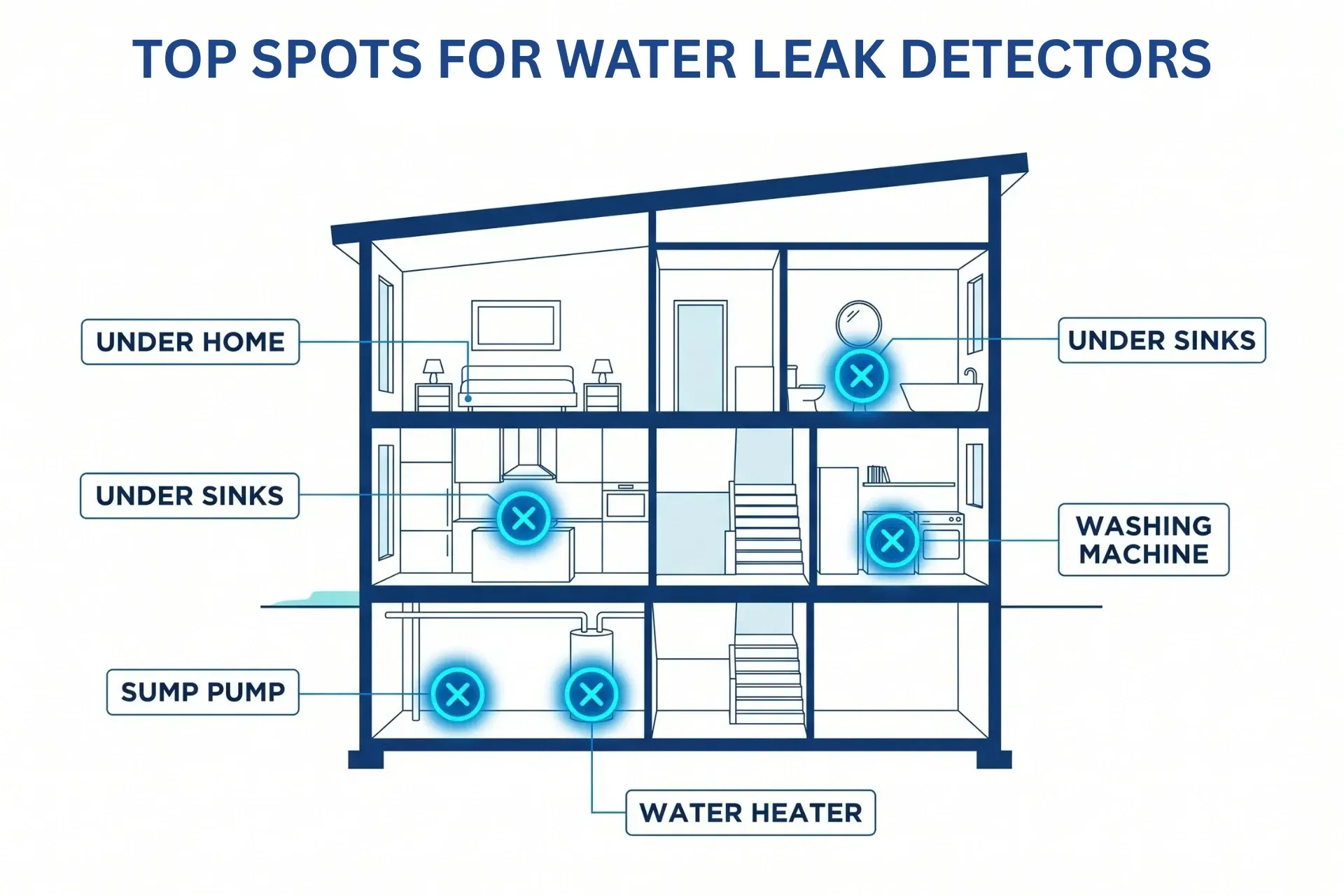
Image Source: Gemini 2026
How Water Leak Detectors Fit Into a Monitored System
A water leak detector integrates with a monitoring system by routing every alert directly to the monitoring team and to your phone. A standalone system is useful on its own, but one connected to active monitoring is even more useful, turning a 2 a.m. alert into a phone call from a real person rather than a notification you might sleep through.
Through the PasWord Connection App, water leak sensors report to the same platform as your smoke, carbon monoxide, and intrusion systems, giving you one dashboard for all environmental hazard systems in your home.
If a leak is detected, our team is on standby, and will reach out to confirm what's happening.
These alerts are device-based: a monitored water leak detector notifies you and, where applicable, our monitoring team when it detects water. It's an added layer of protection, not a substitute for a plumber or a remote shutoff system.
Look for systems that carry ULC (Underwriters Laboratories of Canada) certification. ULC certification means a device has been independently tested against recognized Canadian safety standards, giving homeowners and insurers confidence that the system will perform when it matters.
PasWord Protection offers ULC-certified hazard-detection devices as part of our environmental hazard protection offerings.
Is a Water Leak Detector Worth the Cost?
For most homes, yes. A water leak detector is a small investment compared to the cost of water damage repairs.
Costs vary by system type. A single battery-powered sensor is generally the least expensive option, whereas a smart water leak detection system with several sensors and a hub is more expensive. In-line systems with an automatic shutoff valve cost the most because professional installation is usually recommended, in addition to the hardware.
Water damage is one of the leading causes of claims in Canada. Allstate Canada reports that water damage accounted for
more than 40% of its home insurance claims between 2021 and 2025. Some home insurance providers offer a discount for installing a leak detection system, so ask your insurer directly whether yours qualifies.
How to Choose a Water Leak Sensor
When choosing a water leak sensor, compare detection methods, connectivity, power source, placement fit, and certification, not just price.
| Type |
How it detects |
Alerts when you’re away |
Power |
Installation |
Best for |
|---|---|---|---|---|---|
| Battery-powered point sensor | Water contact | No, local alarm only | Batteries | DIY | One known risk spot |
| Smart, app-connected sensor | Water contact | Yes, push notification | Batteries + Wi-Fi or hub | DIY or professional | Homes often left empty |
| Wired, monitored sensor | Water contact | Yes, to you and a monitoring team | Alarm panel with backup battery | Professional | Whole-home monitoring |
| Flow-based (in-line) system | Water flow and pressure | Varies by model | Varies by model | Professional plumbing | Whole-home supply coverage |
- Detection method. Point sensors are suited to a known risk, such as a water heater. Flow-based systems offer whole-home coverage at a higher cost.
- Connectivity. A local alarm only helps if someone's home to hear it. Wi-Fi or app-connected sensors, tied into a monitored system, close that gap for basements or homes you're often away from.
- Placement flexibility. Check probe length and whether the unit suits the spot where it will be installed, since a system built for a dry floor isn't suited to a damp crawl space.
- False positives. A good system tells condensation apart from a genuine leak; ask any provider how theirs handles false positives.
- Certification and integration. ULC certification serves as a strong indicator of proven, tested dependability. A system that feeds into a larger monitored network, alongside smoke and intrusion detection, outperforms relying on a separate app for each device.
FAQs About Water Leak Detectors
Does a water leak detection system need Wi-Fi to work?
No. Standalone, battery-operated devices trigger an on-site alarm without needing any network connection. Wi-Fi or app-enabled setups add remote alerts, which are especially important for basements or properties you aren’t in all the time.
Can a moisture sensor automatically shut off my water?
Not on its own. Some in-line systems automatically shut off the main valve when they detect a leak. PasWord's monitored sensors focus on fast, reliable alerts to you and our monitoring team, so a shutoff valve or plumber can be brought in quickly.
Is a flood sensor the same as a water leak detector?
Not exactly. A flood sensor typically refers to a sump pit or floor-level device designed to detect rapidly rising water, whereas a water leak detector can also detect slower seepage, such as from a dripping supply line. Many homes use both.
Key Takeaways
- Point sensors, flow-based systems, or both help catch leaks early.
- Install sensors at sump pumps, under sinks, and near water heaters.
- Battery, wired, and smart options all work, but monitoring adds a real person.
- ULC-certified devices meet tested Canadian safety standards.
- Compare detection method, connectivity, power, and ULC certification.
Protecting Your Home Starts With Detection
Water damage tends to build quietly, which is exactly why a detection layer matters. A handful of well-placed sensors in the basement, under sinks, and near the water heater and sump pump can be the difference between a quick fix and a major repair.
As a locally owned and operated business serving homeowners across Hamilton, Halton, Niagara, and the wider Golden Horseshoe, by families, for families, PasWord Protection integrates water leak detection into the same active, proactive approach we use to protect homes from fire and intrusion.
For a closer look at how these systems work together, visit our environmental hazard detection page or read about carbon monoxide detector replacement and smoke detector lifespan, both part of the same environmental hazard cluster.
Ready to add a water leak detector to your home's safety plan? Request a
quote for monitored water leak detection for your basement, sump pump, and water heater.