
Cameras in the Workplace: Employee Rights in Canada
Employers in Canada can use cameras in the workplace, but only under specific conditions. Video surveillance must serve a legitimate purpose, be limited to non-private areas, and comply with federal and provincial privacy laws. Employees must be notified, and audio recording without consent is illegal.
The importance of cameras in the workplace can't be denied, especially with their role in preventing crime, investigating violations, and monitoring suspicious activities. Indoor surveillance cameras in the workplace can help deter theft, improper activity, vandalism, assault, and sexual harassment.
However, business owners and HR decision-makers must know how to implement video surveillance without infringing on employee rights. In this blog, we'll discuss workplace camera regulations, employee rights, Ontario laws on workplace surveillance, and other key information on employee monitoring.
Cameras in the Workplace: Ontario Laws and Key Considerations
In Canada, businesses must follow legal frameworks when installing indoor workplace surveillance. Private-sector organizations are generally subject to the Personal Information Protection and Electronic Documents Act (PIPEDA), which sets out rules for the collection, use, and disclosure of personal information in commercial activities.
Under PIPEDA, businesses must meet three key conditions before installing workplace cameras: a legitimate intention and a reasonable basis, cameras must be placed in appropriate locations, and less intrusive alternatives must be considered first.
1. Intention and Reasoning to Install Surveillance Cameras
A business must have a legitimate reason for installing video surveillance. Merely wanting to video-monitor employee behaviour isn't valid under Canadian law. Suspected criminal activity, such as theft or vandalism, would be considered a legitimate justification.
That reason must be something a reasonable person would accept, and it must be documented before installing cameras.
2. Location of the Surveillance Cameras
Cameras should be installed only in areas where employees have no reasonable expectation of privacy, such as entryways or reception zones. Surveillance is prohibited in private spaces like washrooms, lounges, or locker rooms.
General surveillance of shared spaces is acceptable. Targeting a specific employee is not. Hidden cameras are never appropriate and represent a serious violation of an expectation of privacy under Canadian law.
Once cameras are installed, they must be paired with clear signage in both English and French, as required by Canadian law.
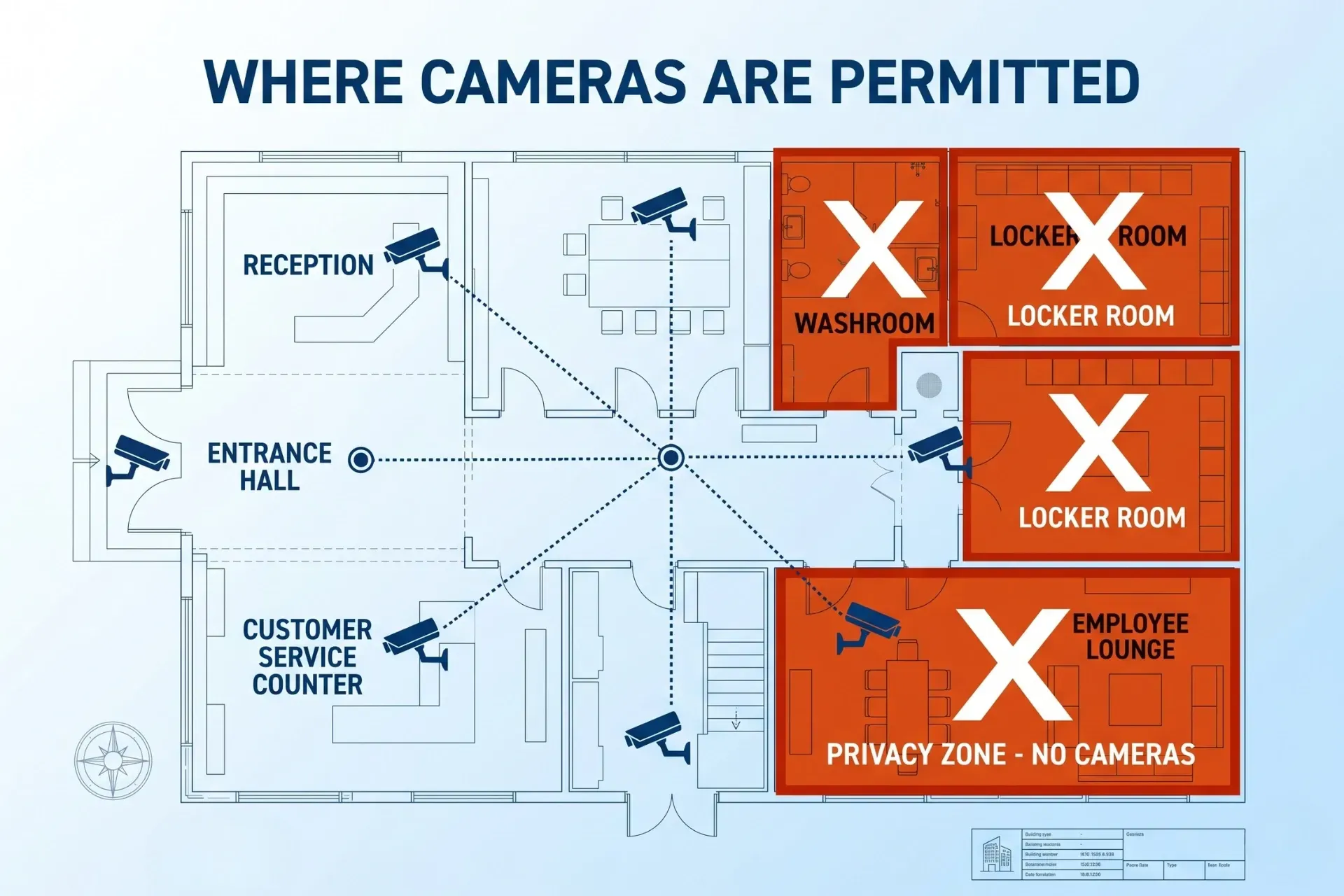
Image Source: Gemini 2026
3. Attempt at Less Intrusive Alternatives
Before installing surveillance, businesses should first try less intrusive means to achieve the same goal, such as key cards, identity badges, or loss-prevention technology. Exhausting these less invasive means first demonstrates the employer is acting in good faith and targeting behaviour rather than individuals.
The Privacy Commissioner of Canada has made clear that workplace surveillance must be justifiable, proportionate, and preceded by an attempt at less intrusive alternatives. Employees may also want to review their employment contract or collective agreement, as these documents sometimes include provisions on workplace surveillance.
Workplace Camera Laws by Province in Canada
While federal PIPEDA applies broadly to private sector organizations, employees, and employers should also be aware of provincial legislation. Workplace surveillance laws in Canada are governed differently depending on where your business operates.
Ontario
In Ontario, private-sector organizations are subject to PIPEDA for video surveillance in the workplace. Public sector employers, such as municipalities and provincial agencies, are covered by the Municipal Freedom of Information and Protection of Privacy Act (MFIPPA).
Under either framework, personal information collected by surveillance cameras can be used only for the originally stated purpose.
The Privacy Commissioner and Ontario's Information and Privacy Commissioner both emphasize that workplace surveillance must be proportionate to the concern being addressed. Video surveillance policy in Ontario also states that disclosure of personal information captured on surveillance video is tightly restricted.
British Columbia (BC)
BC has its own private sector privacy legislation: the Personal Information Protection Act (BC PIPA). Under BC PIPA, employers must have a clear, legitimate reason for installing cameras and must inform employees that surveillance is taking place in the workplace.
Personal information protection under BC PIPA mirrors PIPEDA in many respects, but BC's privacy commissioner has independent authority to investigate complaints and issue binding orders related to video surveillance and employee monitoring.
Alberta
Alberta also operates under its own Personal Information Protection Act (Alberta PIPA). Like BC, Alberta requires employers to notify employees of any surveillance conducted in the workplace and to limit the collection, use, and disclosure of personal information to what is reasonably necessary.
Alberta's privacy commissioner can investigate complaints where employees believe video surveillance has exceeded its stated security purposes. Financial institutions, retail stores, and other commercial operators in Alberta must meet these standards regardless of size.
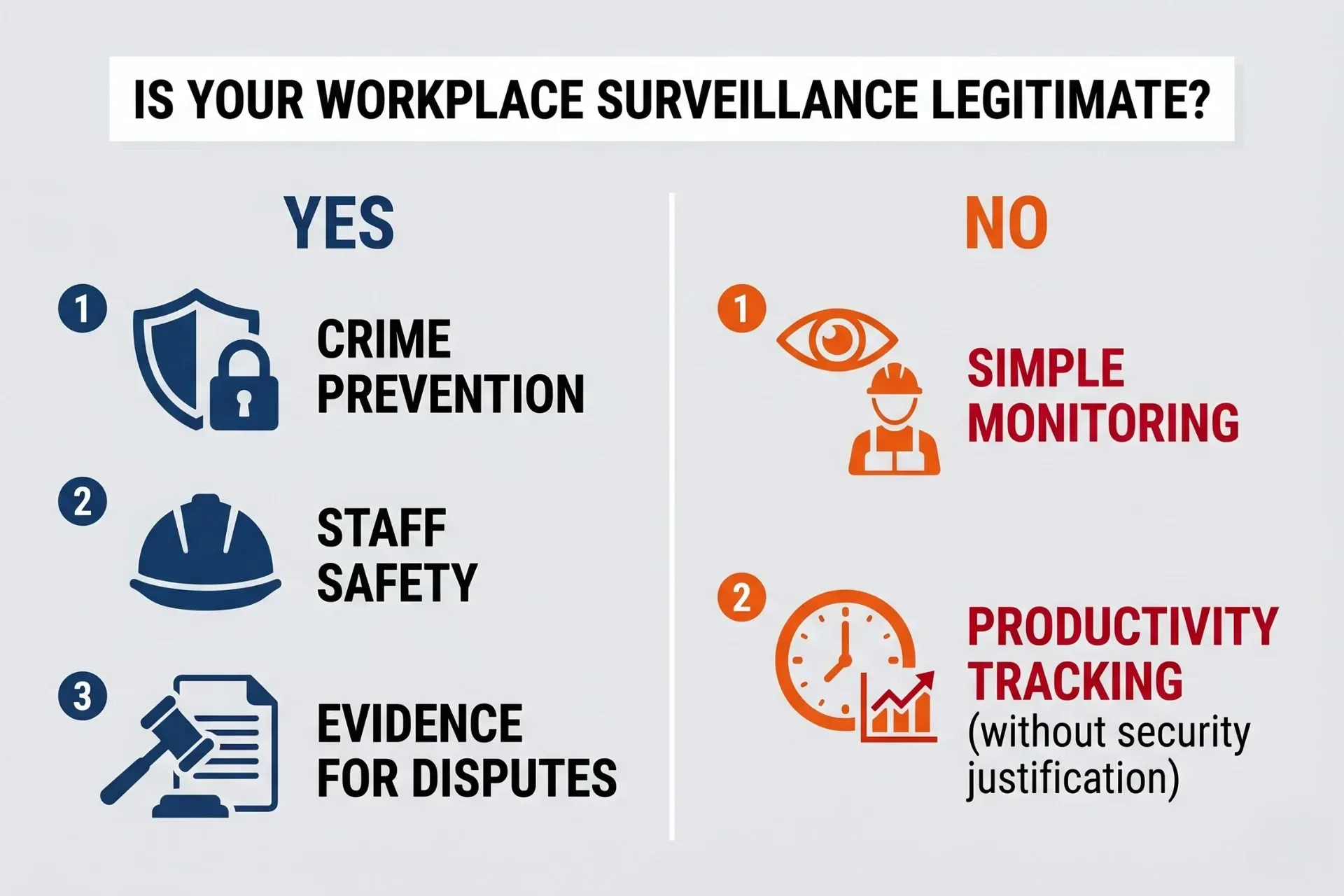
Image Source: Gemini 2026
Can Employers Record Audio in the Workplace?
No, employers cannot record audio in the workplace.
Under Canada's Criminal Code, it’s a criminal offence to intercept private conversations without consent. This applies to any form of audio recording in the workplace, whether via surveillance cameras with built-in microphones, audio tapes, or other methods.
Audio recording without consent is illegal in Canada, regardless of circumstances. Even if a video surveillance system is otherwise lawfully installed, activating its audio function without employees' knowledge and consent violates the Criminal Code.
Installing cameras with audio in the workplace violates employee rights, and employers who attempt to record video with audio in shared or private spaces face serious legal consequences.
If you're considering a video surveillance system for your business, make sure any equipment you install does not capture audio, and confirm this with your security provider before installation.
Can An Employer Watch You on Camera From Home?
Employers cannot watch employees through personal devices or home cameras without explicit consent. Covert monitoring of employees working from home, including activating webcams without consent, is not permitted.
Employers do have some ability to monitor activity on company-owned devices and networks, but this must be disclosed, typically through an employment contract or a formal video surveillance policy.
Any workplace surveillance, even in a home office, must meet the same standards of proportionality, purpose, and notification that apply to physical office surveillance.
If your employer has implemented any form of remote monitoring, it should be outlined in your employment contract and communicated clearly before it begins.
Why Use Cameras in the Workplace?
Video surveillance in the workplace delivers real benefits for businesses and employees alike: it can improve safety, provide supporting evidence in case of conflict, and increase employee productivity.
When implemented correctly, video surveillance cameras reduce employee theft and vandalism by deterring improper activity before it occurs. They also improve staff safety by creating a more secure environment.
Should workplace conflicts arise, surveillance video provides captured evidence that can support a fair resolution. Some businesses also report increased productivity when employees understand that general surveillance is in place.
Retail stores, financial institutions, warehouses, and office environments all benefit from properly managed surveillance in the workplace, provided it's implemented transparently and in compliance with Canadian law.
Read more: Importance of a Security System

Image source: Unsplash
How to Implement Cameras in the Workplace
If you've decided to install indoor surveillance cameras in your workplace, a few steps will ensure it's done properly.
- Start by speaking with our security experts to find the right package for your business, including a free consultation and professional installation.
- Next,
inform employees about the surveillance. Employees who previously worked in a non-monitored environment are more likely to be concerned, which is why proper signage and advanced communication are important. Surveillance should feel like a shared commitment to safety, not secretive.
- Have cameras installed at main entry points to monitor who enters and leaves. Place cameras facing main hallways or indoor intersections to monitor access throughout the building.
We offer secure 24/7 commercial monitoring services for remote surveillance and a quick response in the event of forced entry, vandalism, theft, or other unexpected situations. Remote surveillance access also makes quick checking on the go possible.
Don't install cameras in secretive locations. Hidden placement not only infringes on a reasonable expectation of privacy, but it can also create serious legal exposure and damage employee trust.
For compliant surveillance camera installations, it’s best to work with experienced security professionals familiar with the laws governing security cameras in Canada, whether in the workplace or at home.
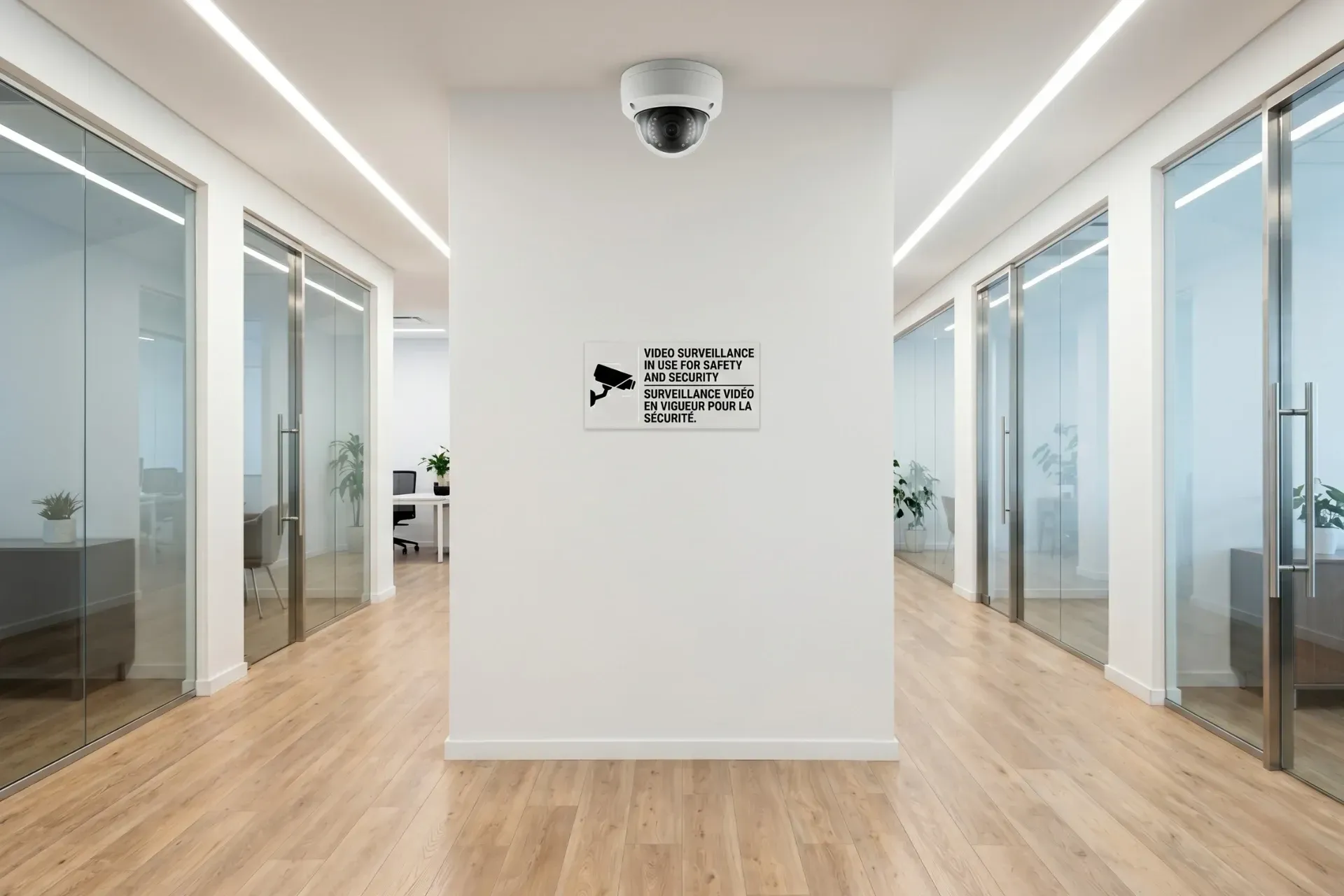
Image Source: Gemini 2026
FAQs About Video Surveillance in the Workplace
Is it legal to watch employees on camera in Canada?
Yes, under specific conditions. Workplace surveillance laws in Canada state that video surveillance must serve a legitimate purpose, be limited to areas where employees have no reasonable expectation of privacy, and be accompanied by clear signage. Covert or targeted surveillance is not permitted.
What are the privacy rights of employees in Canada?
Canadian employees have the right to be informed about surveillance in the workplace, to have their personal information used only for its stated purpose, and to file a complaint with the Privacy Commissioner of Canada if they believe their rights have been violated.
Do you have to tell employees they are on camera?
Yes. Employers must notify employees that video surveillance is in place. This is typically done through visible signage and, where applicable, through an employment contract or workplace policy.
Can an employee record audio at the workplace in Canada?
Employees recording private conversations without consent may also face consequences under Canada's Criminal Code. Recording a conversation you are a party to is generally permissible, but recording others without their knowledge is not.
Is it illegal to record a conversation without consent in Canada?
Yes. Under the Criminal Code, intercepting private conversations without consent is a criminal offence. This applies to both employers and employees and extends to audio recordings made with any device, including surveillance cameras.
Key Takeaways
- Video surveillance in Canadian workplaces must have a legitimate purpose, be limited to non-private areas, and be disclosed to employees through proper signage.
- Audio recording without consent is illegal under Canada's Criminal Code, even when paired with an otherwise lawful video surveillance system.
- Provincial privacy laws in Ontario, BC, and Alberta each carry independent requirements that employers must meet alongside federal PIPEDA.
- Remote employee monitoring must be disclosed in an employment contract or video surveillance policy and cannot include covert access to personal devices or home cameras.
Connect with One of Our Security Experts for the Next Steps
When it comes to video surveillance and office security, trust Ontario's number one business security solutions company: PasWord Protection.
Our high-end indoor surveillance cameras equip businesses with peace of mind, control, insight, and security. Using advanced detection equipment and cloud storage, we ensure easy footage retrieval and a 24/7 remotely monitored feed for constant safety and support.
With over 60 years of experience serving families and businesses across the Golden Horseshoe, we take your safety seriously. Our main goal is to make workplaces safer and more efficient, and we're ready to start working with you.
Ready to take safety and security to the next level? We're always ready to consult and help you understand where workplace surveillance is lacking and how we can improve it.
Get in touch with us now for a safer, more confident workplace.